

Projects

Each fall, the Directors of the Northeast Association of Fish and Wildlife Agencies award the annual RCN grants. Project descriptions below are organized by the year that the grant was funded. Some grants are for more than one year. As grant recipients complete their work, progress reports, and eventually a final report, will be attached to the project description. Updates will generally be available quarterly.

Implementing Bird Action Plans for Shrubland Dependents in the Northeast

Project Director:
Robert McDowel, Executive Secretary, Northeast Association of Fish and Wildlife Agencies, rmcdowellowa@yahoo.com, 116 East Shore Lake Owassa Road, Newton NJ 07860, (973) 948-7643

Proposal to Establish a Regional Initiative for Biomass Energy Development for Early-Succession SGCN in the Northeast

Project Director:
Jefferson L. Waldon, Executive Director, Conservation Management Institute, Virginia Polytechnic Institute and State University,fwiexchg@vt.edu, 1900 Kraft Dr. Suite 250 MS0534, Blacksburg, VA 24061, 540/231-4540 voice, 540/231-7019 fax

Other Principal Investigators:
Scott Klopfer, Conservation Management Institute

An Interactive, GIS-Based Application to Estimate Continuous, Unimpacted Daily Streamflow at Ungaged Locations in the Connecticut River Basin

Project Director:
Stacey A. Archfield, Hydrologist, MA-RI Water Science Center, U.S. Geological Survey, sarch@usgs.gov, USGS MA-RI WSC, 10 Bearfoot Road, Northborough, MA 01532, 508-490-5072, 508-490-5068

Other Principal Investigators:
Elizabeth Ahearn, Hydrologist, CT Water Science Center, U.S. Geological Survey
Peter A. Steeves, Physical Scientist, MA-RI Water Science Center, U.S. Geological Survey
Peter K. Weiskel, Associate Director, MA-RI Water Science Center, U.S. Geological Survey
Keith W. Robinson, Director, NH-VT Water Science Center, U.S. Geological Survey

The Conservation Status of Key Habitats and Species of Greatest Conservation Need in the Eastern Region

Project Director:
Mark G. Anderson Ph.D., Director of Conservation Science, The Nature Conservancy, Eastern Region, manderson@tnc.org, 11 Avenue de Lafayette, 5th floor, Boston, MA 02111, 617-542-1908 x 215 phone, 617-482-5866 fax

Other Principal Investigators:
Charles Ferree MS., Landscape Ecologist, The Nature Conservancy, Eastern Region
Arlene Olivero MS., Aquatic Ecologist, The Nature Conservancy, Eastern Region

Development of Avian Indicators and Measures for Monitoring Threats and Effectiveness of Conservation Actions in the Northeast

Project Leader: Dan Lambert, Northeast Bird Monitoring Coordinator, Chair of the Northeast Mountain Bird Working Group, American Bird Conservancy, c/o Vermont Institute of Natural Science, PO Box 1281, Quechee, VT 05059, dlambert@abcbirds.org, Phone: 802-359-5001 ext 232, Fax : 802-359-5001

Other Principal Investigators:
David Adams, Senior Wildlife Biologist, Chair of the Northeast Marsh Bird Working Group, New York State Department of Environmental Conservation
Michael Morgan, Wildlife Ecologist, Chair of the Northeast Grassland Bird Working Group, Audubon New York

Identifying Relationships between Invasive Species and Species of Greatest Conservation Need in the Northeast Region

Project Director:
Glen N. Stevens, Ph.D., Research Scientist, Conservation Management Institute, Virginia Polytechnic Institute and State University, glsteven@vt.edu, 1900 Kraft Dr. Suite 250 MS0534, Blacksburg, VA 24061, 540.231.2671, 540.231.7019

Other Principal Investigators:
Jefferson L. Waldon, Executive Director, Conservation Management Institute, Virginia Polytechnic Institute and State University

Northeast Regional Connectivity Assessment Project

Project Director:
Terry Cook, Director of Science, Eastern U.S. Conservation Region, The Nature Conservancy, tcook@tnc.org, 490 Westfield Road, Charlottesville, VA 22901, 434) 951-0589 (Phone), (434) 979-0370 (Fax)

Other Principal Investigators:
Mark Anderson, Ph.D., Director of Conservation Science, Eastern US
Conservation Region, The Nature Conservancy
Arlene Olivero, Aquatic Ecologist, Eastern U.S. Conservation Region, The Nature Conservancy
Mark P. Smith, Director, Eastern U.S. Freshwater Program, The Nature Conservancy

Creation of Regional Habitat Cover Maps: Application of the NE Terrestrial Habitat Classification System

Project Director:
Mark G. Anderson Ph.D., Director of Conservation Science, The Nature Conservancy, Eastern Region, manderson@tnc.org, 11 Avenue de Lafayette, 5th floor, Boston, MA 02111, 617-542-1908 x 215 phone, 617-482-5866 fax

Other Principal Investigators:
Lesley Sneddon MS., Senior Regional Ecologist East, NatureServe
Susan C. Gawler Ph.D., Regional Vegetation Ecologist East, NatureServe

Northeastern Wildlife Habitat Classification and Mapping Project

With the creation and implementation of State Wildlife Action Plans (SWAP), the need for consistent, current digital habitat maps has grown dramatically. The implementation of the SWAPs within each state and across the Northeast region will be greatly enhanced through the development of current, consistent terrestrial and aquatic habitat geographic information systems (GIS) datasets.

Regional Monitoring and Performance Reporting Framework

The Regional Monitoring and Performance Reporting Framework project will assist Northeastern states meet the species, habitat and conservation action effectiveness monitoring and performance reporting requirements of the State Wildlife Action Plans (SWAP). Every state recently developed a SWAP, which pro-actively plot out the steps required to conserve wildlife and vital wildlife habitat before they become more rare and costly to protect.

Exploring the Connection Between Arousal Patterns in Hibernating Bats and White Nose Syndrome: Immediate Funding Needs for the Northeast Region

Project Director:
DeeAnn M. Reader, PhD
Department of Biology
Bucknell University
Lewisburg, PA 17837

570-577-1208
dreeder@bucknell.edu

The objective of this project is to determine if the hibernating patterns of bats are disrupted (which could lead to starvation) by monitoring little brown bats at affected sites, suspected sites, and control sites during 2008-2009. Bat and hibernacula monitoring activities will include collecting:

  • temperature and arousal data associated with the hibernating patterns of little brown bats using WeeTag dataloggers;

An interactive, GIS-based application to estimate target fish communities in Northeastern streams (2008)

The overall goal of this project is the development, testing and application of a regional tool for assessing the need for management actions in a watershed to protect the health of aquatic fauna and estimating the amount of water needed to sustain healthy aquatic ecosystems. To achieve this goal, we will build on several ongoing research efforts of ours (see Related Research below). Our specific objectives are to:

Development of Model Guidelines for Assisting Local Planning Boards with Conservation of Species of Greatest Conservation Need and their Key Habitats through Local Land Use Planning (2008)

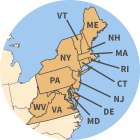
NatureServe, Defenders of Wildlife (Defenders), the Environmental Law Institute (ELI), the Pennsylvania Natural Heritage Program (PHNP), and the Virginia Natural Heritage Program (VNHP) will collaborate to provide a survey and synthesis of the programs, policies and innovations throughout the 13 Northeastern states (from Maine to Virginia). The products will integrate conservation information on species of greatest conservation need (SGCN) and their habitats with land use planning decisions.

Regional Indicators and Measures: Beyond Conservation Land (2008)

A report summarizing the status of approximately 30 key indicators and measures specific to eight habitats and two regional species groups. The report will effectively implement 75% of the NEAFWA’s Northeast Monitoring and Performance Reporting Framework (Tomajer et al. in prep) developed with funding from the National Fish and Wildlife Foundation in 2006. A steering committee of scientists representing Fish and Wildlife agencies, private organizations and others, will direct the work.

Regional Focal Areas for Species of Great Conservation Need based on Site Adaptive Capacity, Network Resilience and Connectivity (2008)

Focal areas for 500 species of great conservation concern will be identified with respect to their resilence and adaptive capacity. The analysis will utilize a previously compiled regional database of over 40,000 known species locations, contributed by the Natural Heritage programs and ranked for current viability through the TNC ecoregional planning assessments. A regional team of scientists representing public and private agencies will develop criteria to assess each site/occurrence relative to three factors: 1) site adaptive capacity, 2) network resilience and 3) connectivity.